Estonia consistently performs well in international education assessments. In PISA 2022, the country placed first in Europe across all assessed fields – and among the top performers globally. But what explains these results?
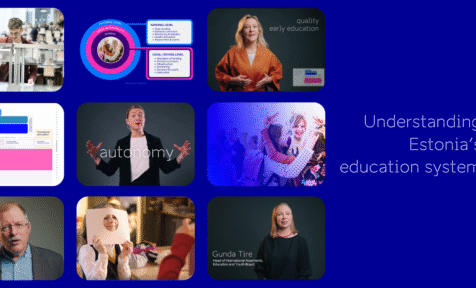
Rather than pointing to a single reform, Estonian educators describe their success through what they call the Estonian school model – a framework built on four principles: an aim high mindset, autonomy, equity and evidence, and societal support. These qualities have developed over decades – some over centuries – and continue to shape how Estonia thinks about education.
Aim high mindset
The aim high mindset has deep roots in Estonian culture. Historically, education was the only path to a better life and a means of preserving national identity. This cultural memory lives on in high expectations for students, teachers, and schools.
In Estonian schools, this means a demanding curriculum with strong academic content. Teachers hold master’s degrees and maintain high professional standards. Students are expected to take responsibility for their learning.
High expectations are paired with a belief that all students can succeed – Estonia ranks first globally for growth mindset. This combination helps explain why, according to PISA 2022, the country produces 1.5 times more top performers and half as many low performers compared to the OECD average.
Autonomy
Soon after regaining independence in 1991, Estonia deliberately gave significant decision-making authority to schools and teachers. This remains a defining feature of the system.
Schools create their own development plans, design curricula within the national framework, and hire teachers. In the classroom, teachers decide on content, methods, and assessment. PISA 2022 confirms that Estonia ranks first globally for teachers’ freedom to shape curriculum and participate in school management decisions.
Autonomy works because it is balanced by strong teacher education, shared national standards, and a commitment to evidence-based improvement. The result is a diverse school network where different pedagogical approaches coexist without compromising overall quality.
Equity and evidence
Estonian education policy aims to give all students, regardless of background, access to quality education. This is embedded in practical policies: free school meals and learning materials, inclusive education from preschool, and funding formulas designed to minimise the impact of local income differences.
The system is also evidence-based. Schools use systematically collected data for self-evaluation and benchmarking. National assessments focus not only on academic outcomes but also on wellbeing and general competencies.
The link between family background and student achievement is weaker than in many countries, although recent data suggests this gap has begun to widen – and addressing this is now a policy priority.
Societal support
Estonian education stands out for how deeply it is embedded in society. Education is regarded not just as a school responsibility, but as everyone’s business.
Municipalities run an extensive kindergarten system where structured learning begins at age three. The hobby education system – over a century old – provides opportunities in music, sports, art, and technology; around 80 per cent of school-age children participate in some form of hobby education. Families are actively engaged in supporting their children’s learning.
The private sector and civil society also play a role. Tech entrepreneurs have established initiatives like the Good Deed Education Fund, which supports teaching quality and school leadership. Programmes such as IT Academy bring industry and education together to shape ICT skills. Some companies even offer internships for school leaders, giving headteachers firsthand experience of the startup world.
From principles to practice
These four principles work together, not in isolation. But some elements of Estonian education success are deeply cultural and cannot simply be replicated. What can be shared are specific practices and approaches developed within this ecosystem – such as teacher training and digital learning solutions.
Readers interested in learning more can explore Estonian education through the Education Estonia services catalogue, where offerings can be filtered by key themes – including aim high mindset, autonomy, equity and evidence, and societal support.