
Estonian vocational education is crafted to meet the labour market demands, placing a substantial emphasis on hands-on experience and flexibility.
In Estonia, vocational education closely aligns with the country’s labour market needs. Students gain practical experience, as practice in enterprises and practical work in school premises is a mandatory and important part of every curriculum
This practical focus is facilitated by the Estonian labour and skills forecasting system known as OSKA, which conducts surveys to forecast future skills and labour needs, ensuring that schools are well-equipped to meet these demands.
Over the last two decades, the vocational education system has undergone extensive reforms: modernizing curricula, optimizing educational networks, and creating large, diverse centres in each county, which offer a wide range of courses to various target groups.
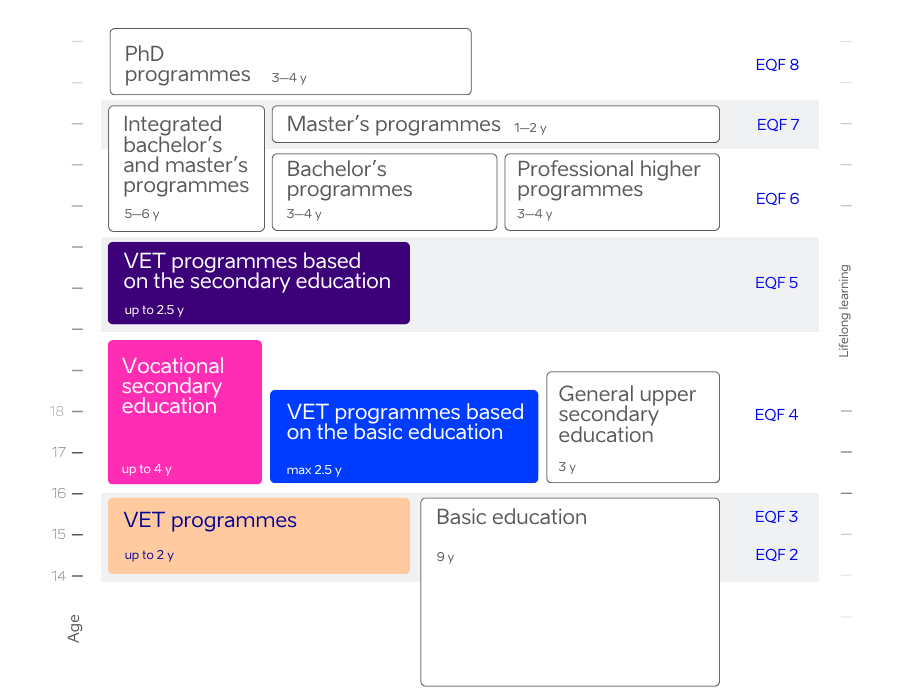
Vocational schools in Estonia enjoy significant autonomy, similar to general education institutions. They offer multiple learning formats, such as school-based and workplace-based training. Programmes are designed around occupational standards, collaboration with local businesses is common, and the curriculas stand out for their strong integration with the labour market.
A notable example of flexible learning opportunities in Estonian vocational education, particularly in the context of fulfilling the obligation to learn, are preparatory studies designed for individuals who are uncertain about their career choice or whose key competences need further development. The programme combines 30% basic studies focused on developing key competences and career planning with 70% elective modules tailored to learners’ individual interests. This flexible structure provides learners with the necessary preparation and support to clarify their future educational or vocational direction and to progress towards further studies at the upper secondary level.
Vocational education in Estonia is diverse, with technical fields, business, and ICT leading in popularity. Other well-attended areas include personal services, arts, and business administration, highlighting the range of opportunities for skill development and career advancement.
The curriculum’s volume is calculated in vocational education credit points, where one credit point equates to 26 hours of study. The standard yearly study volume is set at 60 credit points.
Levels of vocational education
Level 2: Open to individuals with unfinished basic education. The study volume ranges from 60 to 120 credit points, and at least 70% of the curriculum is dedicated to work practice and practical work.
Level 3: Also open to those with unfinished basic education, offering 60 to 120 credit points. At least 50% of the curriculum involves work practice and practical work.
Level 5: Requires secondary education for admission and is divided into:
Vocational education in Estonia is generally accessible to learners with different educational backgrounds and career pathways. Admission requirements vary by programme and may include specific prior education or knowledge requirements. While vocational education is predominantly publicly funded, tuition fees may apply in certain cases, including for repeat learners and those studying in a foreign language. Eligibility for tuition-free education depends on the learner’s previous participation in publicly funded education, the level and type of programme, and other applicable conditions. Applicants can use the SAIS (Student Admission Information System) to check programme-specific admission requirements and their eligibility for tuition-free study.
To graduate from a vocational programme in Estonia, learners must fulfil the requirements of the curriculum and achieve the prescribed learning outcomes. In general, the achievement of learning outcomes is assessed through a practical skills demonstration, vocational examination, school examination, or state examination, depending on the type of vocational programme. In vocational programmes where a skills demonstration is required, learners demonstrate the professional skills needed for employment in a practical work situation. The skills demonstration may also be conducted as a vocational examination and, where applicable, completed in parts throughout the programme.
In the 2025/2026 academic year, vocational education was provided by 30 vocational education institutions and four state-owned institutions of professional higher education offering vocational programmes. The 30 vocational education institutions comprised:
From the 2026/2027 academic year, the state-owned vocational education institutions in Tallinn will be reorganised into two larger institutions. This reform aims to consolidate vocational education provision and strengthen the capacity of the institutions to offer a broader range of programmes and services.
Additionally, 4 universities of applied sciences also offer vocational education programs.
A residence permit for study is required if:
Detailed information is available on the Police and Border Guard Board website.
Get our newsletter
Subscribe to the Education Estonia newsletter
