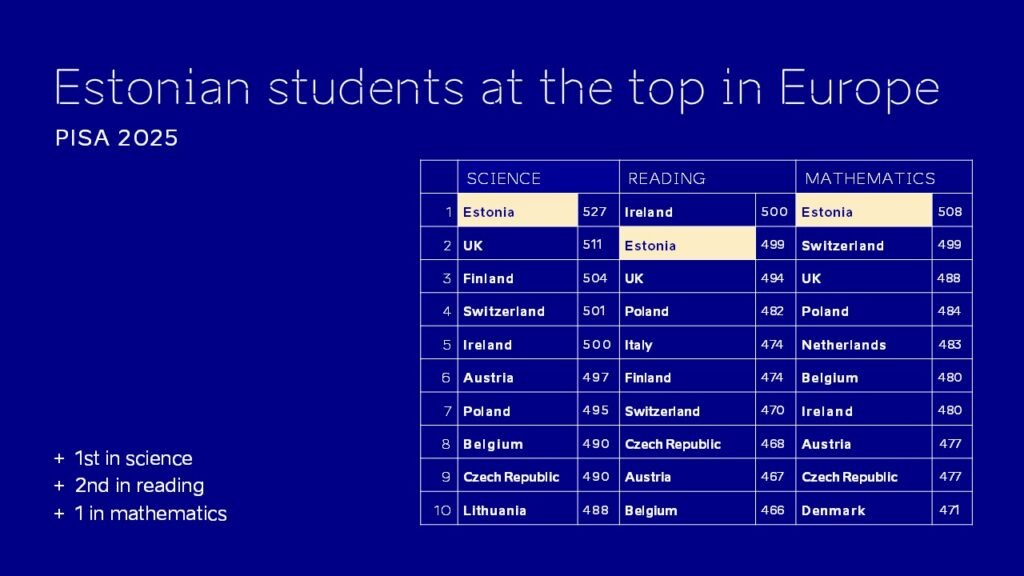
The OECD PISA 2025 results place Estonia among the highest-performing education systems in the world and at the top in Europe.
Estonian students achieved strong results across all major domains, while the study also highlights the strengths of Estonia’s equitable education system and areas that require further attention.
Key results at a glance
| Estonia | OECD average | |
| Science | 527 | 482 |
| Reading | 499 | 461 |
| Mathematics | 508 | 463 |
Estonia’s results in PISA 2025
Estonia’s strength in PISA 2025 lies not only in high average scores, but also in the strong performance of a large share of students and a relatively equitable education system. Compared with many other countries, students’ success depends less on their socio-economic background.
Estonia ranks 1st in Europe in science, mathematics and computational problem solving. In reading, Estonia ranked 2nd in Europe, one point behind Ireland. The difference was not statistically significant.
The results show that Estonia continues to combine high achievement with equity. A large share of students reach at least the baseline level of proficiency, while many also perform at the highest levels.
What the results tell us about Estonian education
“One of the strengths of Estonia’s education system is that strong learning outcomes are not a privilege reserved for a small group of young people.”
Kristina Kallas, Minister of Education and Research
The PISA 2025 results highlight several strengths of the Estonian education system.
Estonia has the highest share of students among participating countries who believe that their abilities can be developed through effort, hard work and feedback. A total of 83% of Estonian students share this growth mindset.
Students also demonstrate strong confidence in their future opportunities. Some 72% believe that they can improve their social position regardless of their background.
Students’ reported life satisfaction improved to 7.4 on a ten-point scale, above the OECD average of 7.2.
The results also show the importance of supportive families and equitable educational opportunities. Socio-economic background has a smaller impact on learning outcomes in Estonia than on average across OECD countries.
At the same time, PISA 2025 highlights several challenges that require continued attention. These include declining reading performance, digital distractions, bullying, teacher shortages, and the need to support the effective and responsible use of artificial intelligence in education.
About PISA
The Programme for International Student Assessment (PISA) is an international study coordinated by the OECD. Conducted every three years, PISA evaluates how effectively 15-year-old students can apply their knowledge and skills in real-life situations. PISA 2025 assessed student performance in science, mathematics, reading and computational problem solving.
- OECD PISA 2025 Results
- OECD PISA 2025 country report: Estonia
- Summary of Estonia’s PISA 2025 results
- PISA Dashboard
Learn more about Estonian education
Interested in exploring the principles, policies and practices behind Estonia’s education system? Our online course Understanding Estonia’s education system introduces key features of the Estonian education system, including teacher education, curriculum development, assessment, digital learning and school life. The course includes insights from experts across the Estonian education sector.